

Blog
MT4 vs MT5 — Which Platform Should You Use in 2026?

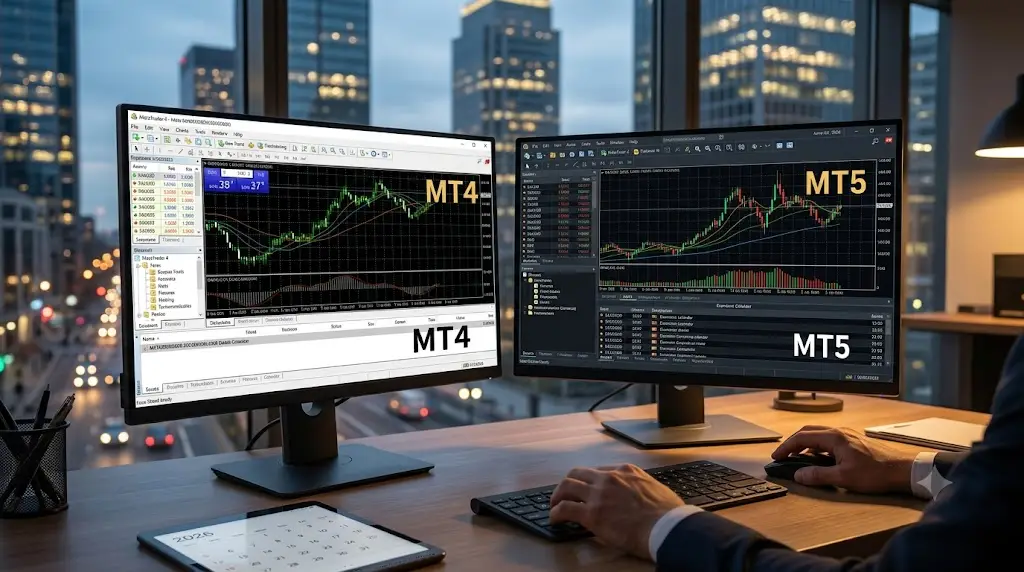
As of 2026, MT5 has firmly established itself as the dominant platform, commanding approximately 62% of the retail CFD market. MetaQuotes ceased issuing new MT4 broker licenses back in 2018. Consequently, any new broker account opened today will almost invariably be on MT5. While MT4 persists with millions of users and legacy broker support, it’s essentially in a maintenance-only phase, receiving security updates but no new features. For anyone starting fresh in 2026, MT5 is the clear, pragmatic choice.
The perennial question for any new forex trader—MT4 or MT5?—has a more definitive answer in 2026 than ever before. However, the nuances remain critical, particularly when evaluating indicators, comparing broker offerings, or contemplating a transition from an established MT4 setup.
This analysis scrutinizes the substantive differences between MT4 and MT5 in 2026, drawing on official MetaQuotes statements and current industry data, to guide your platform selection.
A Brief History — Why MT5 Exists at All
MetaTrader 4, released by MetaQuotes in 2005, rapidly ascended to become the de facto standard for retail forex trading. Its appeal lay in its intuitive interface and the powerful MQL4 scripting language, which fostered a vibrant ecosystem of custom indicators, expert advisors (EAs), and scripts—many freely shared. This robust third-party developer community is the primary engine behind MT4’s enduring relevance.
The pivotal shift occurred in 2018 when MetaQuotes officially ceased the sale of MT4 licenses to new brokers. Existing clients were also restricted from acquiring additional server licenses. This wasn’t a market fluctuation; it was a definitive strategic decision from the platform’s creators.
The practical implication is stark: any broker entering the market post-2018 must acquire MT5. To offer MT4, a new entrant would need to purchase an existing brokerage already holding a license—an impractical and costly maneuver. Consequently, while pre-existing MT4 licenses remain valid, the pipeline for new MT4 adoption has been severed at the source.
MT4 vs MT5 — Who’s Winning in 2026?
By 2026, MetaTrader 5 has unequivocally overtaken MT4 in terms of overall trading volume and market penetration, now accounting for a commanding 62% of the retail CFD sector. For years, MT4 maintained its lead solely on the inertia of its established user base and broker network.
Current data reveals that 68% of global brokers offer MT5, compared to 40% still supporting MT4. A significant 23% provide both. This distribution clearly indicates that brokers are actively expanding their MT5 offerings while retaining MT4 primarily for legacy client retention, not new acquisition.
Feature Comparison — Official Specifications
| Feature | MT4 | MT5 |
|---|---|---|
| Released | 2005 | 2010 |
| New licenses available | No — discontinued in 2018 | Yes — only option for new brokers |
| Asset classes | Forex, CFDs | Forex, CFDs, stocks, futures, options, crypto |
| Timeframes | 9 | 21 |
| Built-in indicators | 30 | 38 |
| Programming language | MQL4 | MQL5 — object-oriented |
| Architecture | 32-bit | 64-bit, multi-threaded |
| Custom indicator file | .ex4 | .ex5 |
| Active development | Maintenance only — security patches | Yes — new features ongoing |
| Economic calendar | Not built-in | Built-in chart overlay |
When MT4 Still Makes Sense
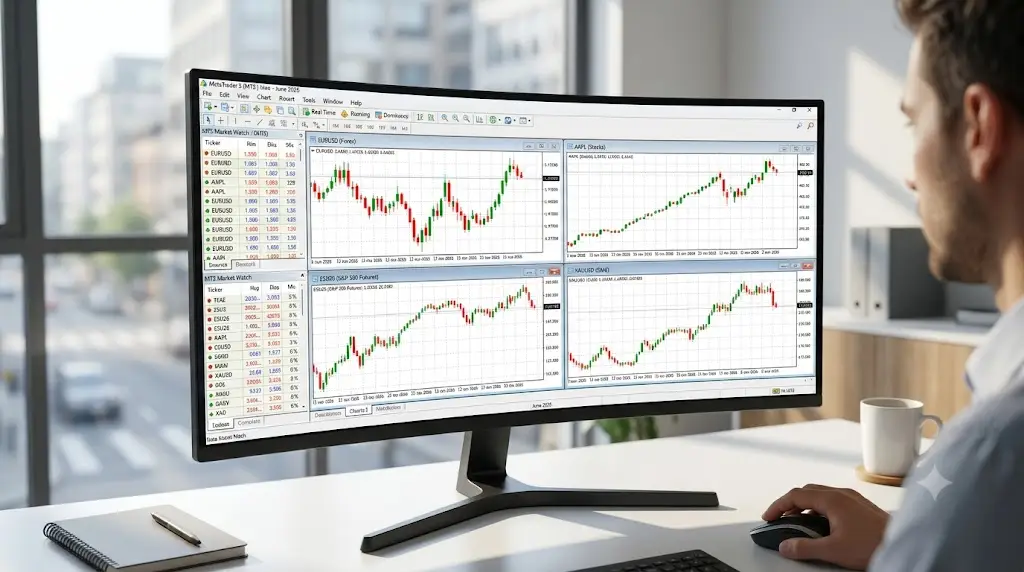
Despite MT5’s market ascendancy, MT4 remains a viable option. Its appeal persists due to its established reliability, user-friendliness, and the vast community support it enjoys. For traders exclusively focused on forex, MT4 offers a streamlined, uncluttered environment.
The primary reasons traders continue to utilize MT4 in 2026 are typically threefold:
- Existing Broker Relationship: Your current broker offers MT4, and migrating accounts, historical data, or custom EAs presents an undesirable hurdle.
- Forex-Centric Trading: Your trading activities are confined to forex and Gold, rendering the broader asset class access of MT5 unnecessary.
- Legacy MQL4 Tools: You depend on custom indicators or EAs specifically coded in MQL4 that have not been ported to MQL5.
What This Means for Indicators
Crucially, MT4 and MT5 indicators are not interchangeable. MT4 utilizes compiled MQL4 code resulting in .ex4 files. MT5 employs MQL5, producing .ex5 files. A native .ex4 file will not function on MT5, and vice versa.
When selecting a signal indicator, the primary consideration is alignment with your broker’s platform. Verify that any indicator purchased is compiled for the specific platform you intend to use. Our comprehensive guide to 2026’s top buy/sell indicators addresses this, highlighting tools with dual-platform compatibility.
The Alpha Indicator stands out as one of the few signal tools offering native support for both platforms. It is provided as a distinct .ex4 file for MT4 and an .ex5 file for MT5, ensuring platform choice does not preclude its use. A detailed examination is available in our Alpha Indicator review.
MT4 vs MT5 for Gold (XAUUSD) Trading
For Gold traders, the platform choice is secondary to the indicator strategy and risk management protocols. Both MT4 and MT5 support XAUUSD trading on any broker offering the instrument. MT5’s 64-bit, multi-threaded architecture generally facilitates more efficient backtesting and order execution—a subtle but potentially beneficial edge during volatile Gold market conditions.
If Gold is your sole focus and you are yet to select a broker, MT5 represents the more forward-looking decision, aligning with where new broker development is concentrated. Consult our dedicated Gold Indicators category and our guide to the best Gold indicators for platform-specific recommendations.
Which Should You Choose? — Simple Decision Framework
- You are opening a new trading account.
- You require access to asset classes beyond forex and CFDs (stocks, futures, options, crypto).
- You desire a broader selection of timeframes and built-in technical tools.
- Faster execution speeds on volatile instruments like Gold are a priority.
- Long-term platform viability and active development are important.
- Your current broker provides robust MT4 support and you are satisfied.
- Your trading is exclusively forex and Gold, with no need for other markets.
- You rely on specific MQL4 indicators or EAs that lack MQL5 equivalents.
- You prefer MT4’s established, less complex user interface.
Our Assessment: For any trader initiating a new account in 2026, MT5 is the pragmatic default. While MT4 remains functional, the cessation of new license issuance and MetaQuotes’ focus on MT5 development make it the future-proof option. If you are already proficient on MT4 and your broker offers strong support, there is no imperative to migrate.
Frequently Asked Questions
Is MT4 being discontinued?
MetaQuotes has ceased issuing new MT4 broker licenses and limits updates to security patches. However, existing licenses permit continued operation indefinitely. Millions of users still actively trade on MT4, meaning it is in a state of supported maintenance, not active discontinuation.
Can I open a new MT4 account in 2026?
Yes, provided your chosen broker secured an MT4 license prior to MetaQuotes’ 2018 policy change. Most new brokerages entering the market today can only offer MT5 due to the unavailability of direct MT4 licensing.
Which platform is better for Gold (XAUUSD) trading?
Both platforms functionally support Gold trading. MT5’s advanced architecture offers marginally faster execution, a potential benefit during XAUUSD’s rapid price swings. However, for most manual traders relying on signal indicators, the quality of the signal itself is a more significant factor than platform-specific execution speed.
Can I use the same indicator on MT4 and MT5?
No. MT4 indicators (.ex4 files, MQL4) are incompatible with MT5 (.ex5 files, MQL5). Reputable indicator developers provide distinct, platform-specific versions, such as the Alpha Indicator, which is available for both MT4 and MT5.
Should I migrate from MT4 to MT5?
A migration is not strictly necessary if your current MT4 setup is satisfactory and your broker fully supports it. Consider switching if you seek broader asset class access, enhanced analytical tools, or if your broker begins to phase out MT4 support. Most brokers offer parallel MT5 accounts, allowing a gradual transition.
Risk Disclaimer: Trading Forex and financial markets carries a substantial risk of loss and is unsuitable for all investors. Platform selection does not mitigate trading risk. Always utilize demo accounts for practice before live trading and consult your broker for platform-specific terms. Trade with due diligence.